Automotive
Mastering show me tell me questions for Driving Test Success

Introduction
For many learner drivers, the practical driving test is one of the most important milestones on the road to independence. While most candidates focus heavily on driving skills such as steering, maneuvering, and observation, there is another section of the test that deserves equal attention: show me tell me questions. These questions assess a driver’s understanding of basic vehicle safety, maintenance, and essential controls.
Understanding vehicle checks is not just about passing an exam. It is about becoming a safer and more responsible driver. Knowing how to inspect tires, check fluid levels, operate lights, and use safety features can prevent accidents and reduce the risk of vehicle breakdowns. That is why examiners include show me tell me questions as part of the practical assessment.
Many candidates lose valuable marks because they underestimate this section. Fortunately, with the right preparation, these questions can become one of the easiest parts of the driving test. This guide explores their purpose, importance, common topics, and effective preparation strategies.
What Is show me tell me questions
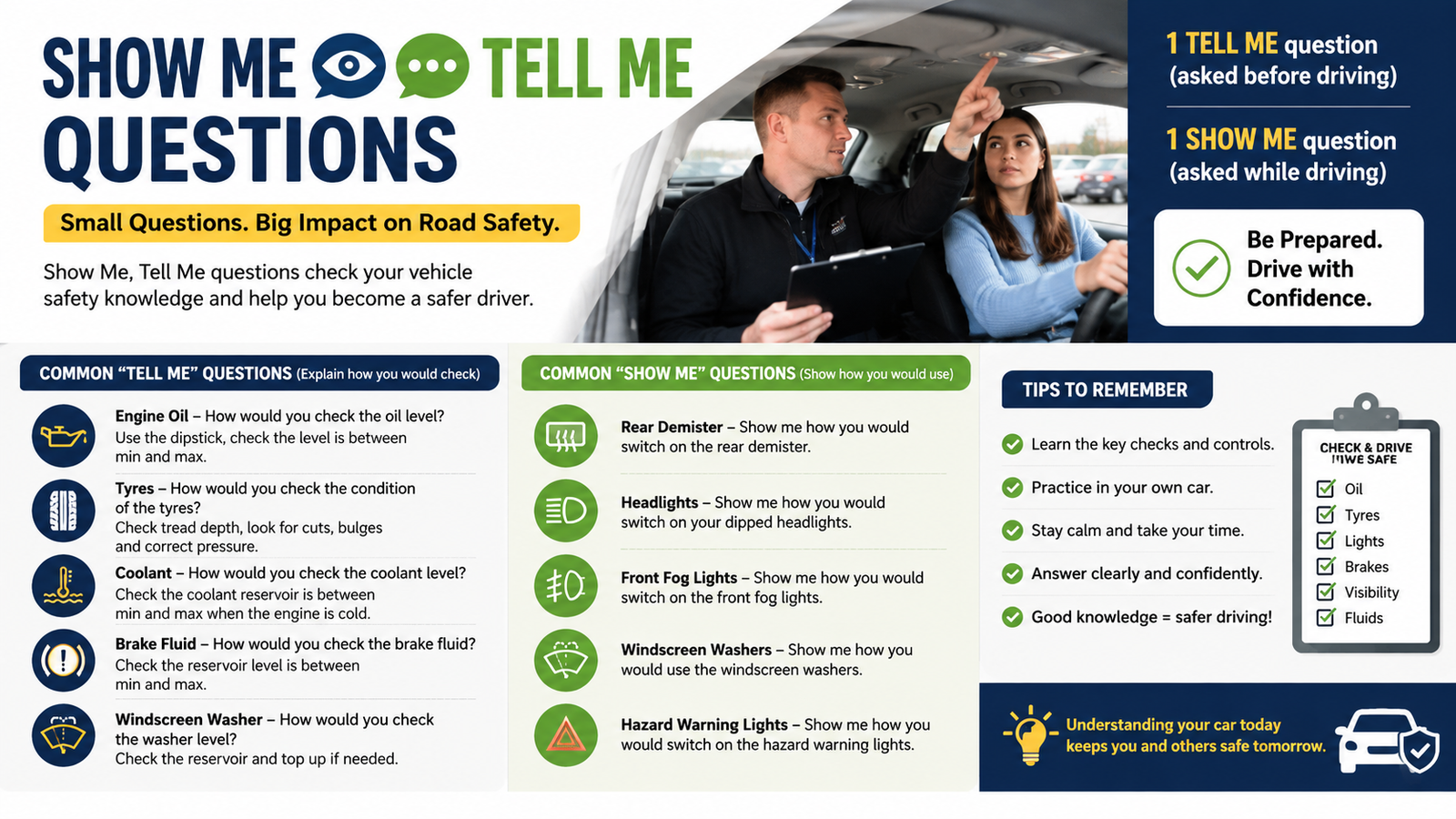
show me tell me questions are vehicle safety questions asked during a practical driving test. They are designed to evaluate whether a learner driver understands essential vehicle maintenance and safety procedures.
The “tell me” question is usually asked before the vehicle begins moving. The candidate must explain how a specific safety check would be performed. The “show me” question is generally asked while driving and requires the candidate to demonstrate the operation of a vehicle control safely.
These questions are not intended to confuse learners. Instead, they verify that drivers possess practical knowledge needed for everyday vehicle operation. Examiners understand that perfect technical expertise is not expected, but a basic understanding of safety-related functions is essential.
Why Vehicle Safety Knowledge Matters
Driving is about much more than controlling a vehicle. Every driver has a responsibility to ensure their vehicle remains roadworthy and safe. A poorly maintained car can become a danger not only to its occupants but also to other road users.
The purpose behind show me tell me questions is rooted in real-world driving situations. For example, a driver who does not know how to check tire pressure may unknowingly drive with unsafe tires. Similarly, failing to understand how to operate demisters or headlights can reduce visibility during challenging weather conditions.
Vehicle-related issues contribute to many road incidents each year. By testing basic maintenance knowledge, driving authorities encourage safer driving habits from the very beginning of a driver’s journey.
The Structure of the Questions
One of the reasons learners find show me tell me questions manageable is their predictable format. Examiners select questions from an established list covering vehicle safety topics.
The “tell me” portion focuses on explaining a procedure. Candidates may be asked how they would check engine oil levels, confirm brake functionality, or inspect tire conditions.
The “show me” portion involves demonstrating a vehicle control while driving. Common examples include activating the rear demister, operating windscreen washers, switching on headlights, or using the horn when appropriate.
Because the range of questions is limited, learners can prepare effectively through repetition and practical experience.
Common Topics Covered in Vehicle Checks
Most show me tell me questions revolve around key vehicle systems that affect safety and performance. Understanding these areas provides confidence both during the test and in everyday driving.
Tires receive significant attention because they directly influence braking, steering, and road grip. Candidates may need to explain how tire pressure, tread depth, and overall condition should be checked.
Lighting systems are another common topic. Drivers must know how to verify that headlights, brake lights, indicators, and rear lights function correctly.
Fluid levels also feature prominently. Knowledge of engine oil, coolant, brake fluid, and windscreen washer fluid is considered essential for safe vehicle operation.
Visibility-related equipment such as windscreen wipers, washers, and demisters is frequently included because clear vision is critical under all driving conditions.
Understanding Tire Safety Questions
Tires are among the most important components of any vehicle. They form the only point of contact between the car and the road surface.
Many show me tell me questions focus on tire condition because poor tires can significantly increase stopping distances and reduce vehicle control. Drivers should understand how to inspect tires for cuts, bulges, and damage. They should also know the legal requirements for tread depth.
Checking tire pressure regularly improves fuel efficiency, extends tire life, and enhances safety. Examiners often expect candidates to explain where correct pressure information can be found and how pressures should be checked.
This knowledge reflects practical driving responsibility rather than simple memorization.
Vehicle Lights and Visibility Checks
Good visibility is fundamental to safe driving. Drivers must be able to see and be seen in a variety of weather and lighting conditions.
Questions relating to vehicle lighting are among the most frequently encountered during show me tell me questions assessments. Candidates may need to explain how they would confirm that brake lights, indicators, or headlights are functioning properly.
Understanding visibility systems goes beyond lighting. Windscreen washers, wipers, and demisters play a critical role during rain, fog, frost, and other adverse conditions. Demonstrating confidence with these controls shows the examiner that the driver can respond effectively to changing environments.
Engine Fluids and Maintenance Awareness
Modern vehicles rely on several important fluids to function correctly. Although many drivers rarely inspect these components, basic maintenance knowledge remains essential.
During show me tell me questions, candidates are often asked how they would check engine oil levels. A complete answer usually involves identifying the dipstick, checking the oil when the engine is cool, and ensuring the level remains between minimum and maximum markings.
Coolant levels help prevent engine overheating, while brake fluid is vital for braking performance. Windscreen washer fluid ensures visibility remains clear during poor weather.
Understanding these checks helps drivers identify potential issues before they develop into costly repairs or safety hazards.
How Examiners Assess Responses
Examiners are not looking for complex technical explanations. Instead, they want evidence that a candidate understands basic safety procedures.
When answering show me tell me questions, clarity and confidence are more important than using advanced mechanical terminology. A simple, accurate explanation is usually sufficient.
Examiners recognize that learner drivers are not professional mechanics. However, they do expect candidates to demonstrate awareness of essential vehicle functions and safety requirements.
A minor error in this section generally results in a driving fault rather than an automatic failure. Nevertheless, preparing thoroughly helps avoid unnecessary mistakes.
Effective Preparation Techniques
Success with show me tell me questions comes from practical familiarity rather than memorization alone. Reading answers repeatedly can help, but physically locating and using vehicle controls provides a deeper understanding.
Spending time inside the vehicle before the test can be extremely valuable. Familiarize yourself with dashboard controls, lighting switches, washer systems, and demister settings. Open the bonnet and identify important components such as oil, coolant, and brake fluid reservoirs.
Many driving instructors dedicate specific lessons to these questions. Taking advantage of these opportunities allows learners to build confidence in a controlled environment.
Regular practice transforms unfamiliar procedures into natural habits.
Common Mistakes Learners Make
Several recurring mistakes appear during show me tell me questions assessments. One of the most common is learning answers without understanding their meaning. Candidates may memorize phrases but struggle when the wording changes slightly.
Another frequent issue involves confusion between different vehicle controls. Learners sometimes activate the wrong switch or hesitate because they are unfamiliar with dashboard layouts.
Some candidates also underestimate the importance of preparation. Because the questions seem simple, they assume last-minute revision will be sufficient. In reality, practical familiarity is often the key to success.
Developing genuine understanding rather than relying solely on memorization helps prevent these errors.
The Role of Confidence During the Test
Confidence can significantly influence performance during show me tell me questions. Nervous candidates may know the correct answer but struggle to express it clearly under pressure.
Building confidence requires repeated practice and exposure. The more familiar a learner becomes with vehicle systems, the less intimidating the questions appear.
Confidence also helps maintain focus during the driving portion of the test. Instead of worrying about vehicle controls, prepared candidates can concentrate fully on road conditions and safe driving decisions.
Remember that examiners want candidates to succeed. They are assessing practical competence, not trying to create unnecessary challenges.
Real-World Benefits Beyond the Driving Test
The value of show me tell me questions extends far beyond obtaining a driving license. Drivers who understand basic vehicle maintenance are better equipped to recognize problems early and respond appropriately.
Routine checks can prevent breakdowns, improve fuel efficiency, reduce repair costs, and enhance safety. Understanding how vehicle systems work also contributes to greater confidence on the road.
Many experienced drivers admit they rarely received formal vehicle maintenance education after passing their test. As a result, the knowledge gained through these questions often remains valuable for years.
Developing these habits early creates a strong foundation for responsible vehicle ownership.
Conclusion
The importance of show me tell me questions should never be underestimated. While they represent a relatively small part of the practical driving test, they assess knowledge that every responsible driver should possess. Understanding tires, lights, fluids, visibility systems, and vehicle controls contributes directly to safer roads and more confident driving.
Preparation is straightforward when approached consistently. Practical experience, familiarity with vehicle controls, and an understanding of basic maintenance procedures can transform this section from a source of anxiety into an opportunity to demonstrate competence.
Ultimately, show me tell me questions are not merely test requirements. They represent essential driving knowledge that supports safety, reliability, and confidence throughout a driver’s lifetime.
FAQs
What are show me tell me questions in a driving test?
They are vehicle safety questions designed to assess a learner driver’s understanding of basic maintenance checks and vehicle controls.
How many show me tell me questions are asked?
Typically, one “tell me” question is asked before driving and one “show me” question is asked while the vehicle is in motion.
Can I fail my driving test because of show me tell me questions?
A mistake usually results in a driving fault rather than an immediate test failure, but multiple faults can affect the overall result.
How can I prepare for show me tell me questions?
Practice with your vehicle, learn the location of key controls, understand basic maintenance procedures, and review common questions regularly.
Why are show me tell me questions important?
They ensure drivers understand essential vehicle safety checks, helping prevent accidents, breakdowns, and maintenance-related problems.

Introduction
Modern vehicles rely on complex safety technologies that work silently in the background until they are needed most. Among these systems, the Anti-lock Braking System (ABS) plays a critical role in maintaining vehicle control during emergency braking situations. While many drivers are familiar with the ABS warning light, fewer understand the testing procedures used to verify that the system is functioning correctly. One of the most important concepts in professional brake diagnostics is abs testauslösung.
In automotive engineering and workshop diagnostics, abs testauslösung refers to the controlled activation or triggering of the ABS system during testing procedures. This process allows technicians to evaluate the behavior of sensors, hydraulic components, electronic control units, and communication systems without waiting for an actual emergency braking event.
As vehicles become increasingly sophisticated, proper ABS testing has become more important than ever. Understanding abs testauslösung helps technicians, students, engineers, and vehicle owners appreciate the complexity behind modern braking technology and the methods used to ensure road safety.
What Is abs testauslösung?
abs testauslösung is a German automotive term that translates roughly to “ABS test triggering” or “ABS test activation.” It describes a diagnostic procedure in which the Anti-lock Braking System is intentionally activated under controlled conditions to verify proper operation.
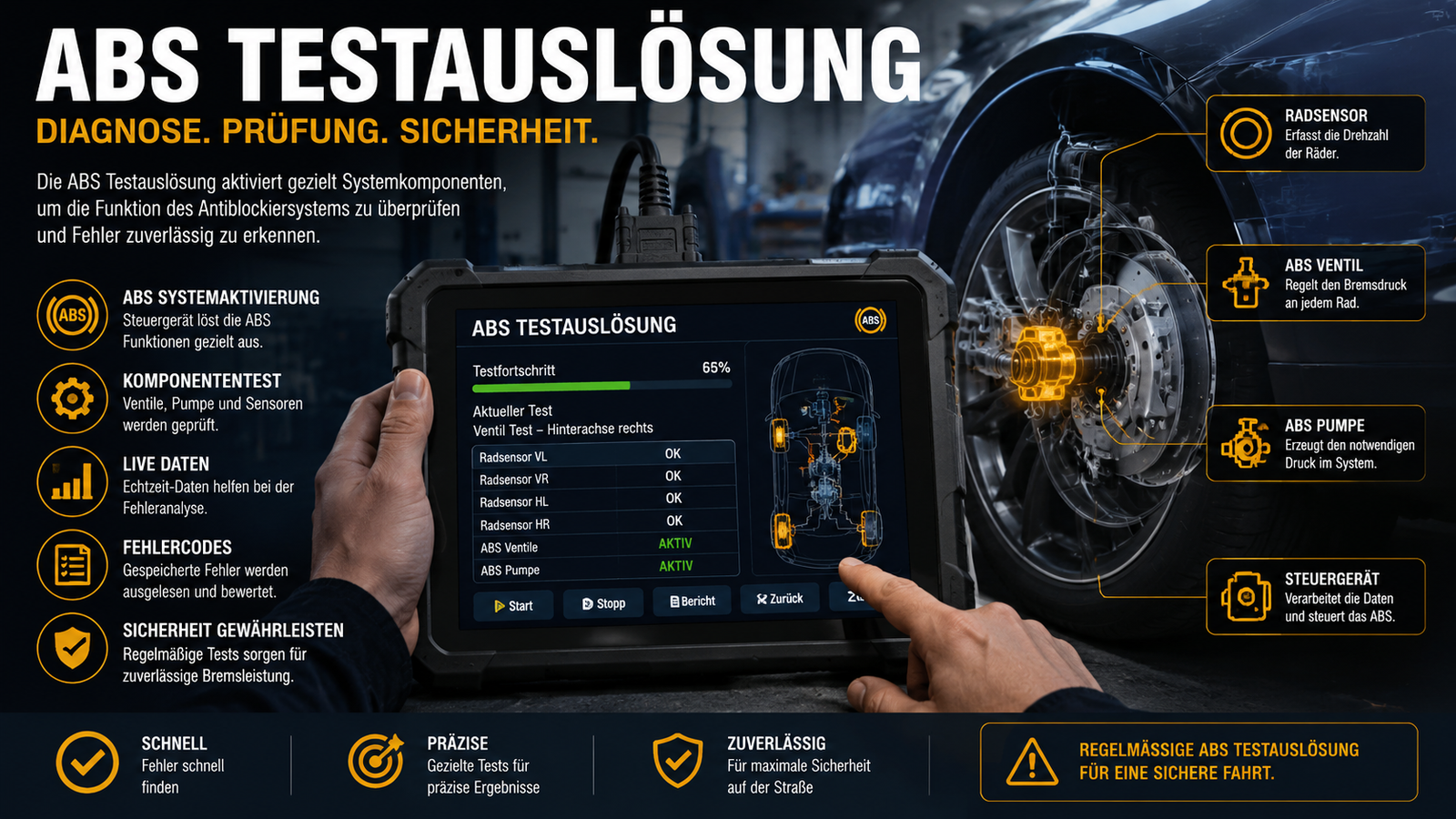
During an abs testauslösung procedure, specialized diagnostic equipment communicates with the vehicle’s electronic systems and commands the ABS module to perform specific functions. These functions may include activating hydraulic valves, operating the ABS pump motor, checking wheel speed sensor signals, or verifying communication between control units.
The purpose of abs testauslösung is not simply to confirm that the ABS warning light remains off. Instead, it provides a deeper analysis of system functionality by allowing technicians to observe how individual components respond during simulated operating conditions.
The Role of ABS in Vehicle Safety
To understand the importance of abs testauslösung, it is essential to first understand the function of ABS itself. The Anti-lock Braking System prevents wheel lock-up during hard braking. When a wheel locks, it loses traction and can no longer provide effective steering control.
ABS continuously monitors wheel speed through sensors located at each wheel. If the system detects that a wheel is about to lock, it rapidly adjusts brake pressure multiple times per second. This process allows the wheel to maintain rotational movement while maximizing braking performance.
Without ABS, drivers could lose steering capability during panic stops, particularly on wet, icy, or uneven road surfaces. Because the system is such a critical safety feature, reliable testing methods like abs testauslösung are necessary to ensure proper operation.
Why abs testauslösung Is Important
The significance of abs testauslösung extends beyond routine maintenance. Modern braking systems involve complex interactions between mechanical, hydraulic, and electronic components. A failure in any part of the system can compromise safety.
Diagnostic activation allows technicians to identify hidden faults that may not trigger immediate warning lights. A sensor could provide inaccurate data, a hydraulic valve might respond slowly, or an electrical connection could be intermittently failing. These issues may remain undetected during standard inspections.
By performing abs testauslösung, technicians gain valuable information about system performance under simulated operating conditions. This proactive approach helps prevent potential failures before they affect vehicle safety.
Components Evaluated During abs testauslösung
Several critical components are examined during an abs testauslösung procedure. The wheel speed sensors are among the most important. These sensors provide real-time rotational data that the ABS controller uses to determine when intervention is necessary.
The ABS control module itself is another major focus. This electronic unit processes sensor information and makes decisions regarding brake pressure modulation. Testing helps confirm that the controller can accurately interpret data and issue commands.
Hydraulic valves are also evaluated. These valves regulate brake fluid pressure to individual wheels during ABS operation. If a valve becomes stuck or sluggish, braking performance may be affected.
The ABS pump motor undergoes examination as well. This component restores hydraulic pressure during ABS intervention. During abs testauslösung, technicians can verify that the pump activates correctly and maintains proper performance.
Electrical circuits, connectors, communication networks, and related safety systems may also be included in the diagnostic process.
How abs testauslösung Is Performed
The process of abs testauslösung typically begins with connecting a diagnostic scanner to the vehicle’s onboard diagnostic system. Modern diagnostic tools communicate directly with the ABS control module and provide access to specialized testing functions.
After establishing communication, the technician selects the appropriate test procedure. The diagnostic software may instruct the ABS module to activate specific valves, run the pump motor, or perform internal self-checks.
Throughout the test, the technician monitors system responses using live data readings and diagnostic feedback. Voltage levels, wheel speed sensor outputs, pressure values, and communication signals may all be observed.
Some advanced procedures involve testing on specialized equipment such as brake test benches. These systems allow controlled simulation of wheel movement and braking conditions, enabling more comprehensive evaluation of ABS performance.
Common Problems Identified Through abs testauslösung
One of the greatest advantages of abs testauslösung is its ability to uncover faults that may otherwise remain hidden. Wheel speed sensor failures are among the most frequently detected issues. Dirt, corrosion, wiring damage, and sensor degradation can all affect signal quality.
Hydraulic valve problems may also become apparent during testing. A valve that fails to open or close properly can reduce braking efficiency and trigger fault codes.
Electrical issues represent another common category of defects. Damaged wiring, poor ground connections, voltage irregularities, and communication errors between modules can all interfere with ABS operation.
Pump motor failures are particularly important because they directly affect pressure regulation during ABS intervention. Testing can reveal weak motor performance long before complete failure occurs.
In many cases, abs testauslösung helps technicians pinpoint the exact source of a problem, reducing diagnostic time and improving repair accuracy.
Advanced Diagnostic Technology and ABS Testing
Modern vehicles incorporate increasingly sophisticated diagnostic capabilities, making abs testauslösung more effective than ever. Contemporary diagnostic platforms provide real-time monitoring of multiple vehicle systems simultaneously.
Many ABS modules now perform continuous self-monitoring during vehicle operation. However, controlled testing remains essential because certain components can only be evaluated under specific conditions. Active diagnostic commands allow technicians to verify component behavior directly rather than relying solely on stored fault codes.
Some advanced systems integrate ABS with traction control, electronic stability control, and autonomous emergency braking technologies. As these systems become interconnected, comprehensive testing procedures gain even greater importance.
The evolution of diagnostic technology continues to improve the precision and reliability of abs testauslösung procedures across a wide range of vehicle manufacturers.
Challenges in ABS Diagnostic Testing
Despite significant technological advancements, performing abs testauslösung can present challenges. Vehicle manufacturers often use different testing protocols, requiring technicians to understand brand-specific procedures.
Environmental factors may also influence testing outcomes. Battery voltage fluctuations, communication interruptions, or mechanical wear can affect diagnostic results.
Intermittent faults remain among the most difficult issues to identify. A sensor that fails only under certain temperatures or driving conditions may require repeated testing before the problem becomes evident.
Additionally, modern vehicles contain multiple interconnected control modules. A fault in one system can sometimes produce symptoms that appear related to ABS even when the root cause lies elsewhere. Skilled interpretation of diagnostic data is therefore essential.
abs testauslösung in Professional Workshops
In professional automotive workshops, abs testauslösung has become a standard part of advanced brake diagnostics. Technicians receive specialized training to understand system architecture, diagnostic procedures, and manufacturer-specific requirements.
Repair facilities often invest heavily in diagnostic equipment capable of performing comprehensive ABS testing. These tools provide access to functions unavailable through basic code readers, allowing deeper analysis of system behavior.
Professional testing not only improves repair quality but also enhances customer confidence. When a technician can verify system performance through controlled activation procedures, the likelihood of unresolved issues is significantly reduced.
As vehicle technology continues to evolve, workshop reliance on advanced ABS diagnostics is expected to grow even further.
The Future of ABS Testing and Diagnostics
The future of abs testauslösung is closely linked to broader developments in vehicle technology. Advanced driver assistance systems, connected vehicles, and increasingly sophisticated braking technologies are transforming automotive diagnostics.
Future ABS systems may incorporate predictive algorithms capable of detecting potential failures before symptoms become noticeable. Enhanced sensor technology and faster data processing could further improve diagnostic accuracy.
Remote diagnostic capabilities may also expand, allowing certain aspects of ABS monitoring to occur without traditional workshop visits. However, controlled activation testing will likely remain an essential tool for verifying component functionality and system integrity.
As automotive safety standards continue to advance, abs testauslösung will remain a vital procedure for maintaining reliable braking performance.
Conclusion
abs testauslösung is far more than a technical diagnostic term. It represents a critical process that helps ensure one of the most important vehicle safety systems operates correctly when needed most. Through controlled activation of ABS components, technicians can evaluate sensors, valves, control modules, pump motors, and communication systems with remarkable precision.
The growing complexity of modern vehicles makes advanced diagnostic procedures increasingly important. By identifying hidden faults, improving repair accuracy, and verifying system functionality, abs testauslösung contributes directly to road safety and vehicle reliability.
Whether viewed from an engineering perspective, a workshop diagnostic standpoint, or a vehicle owner’s interest in safety technology, understanding abs testauslösung provides valuable insight into the sophisticated systems that help keep drivers safe every day.
FAQs
What does abs testauslösung mean?
abs testauslösung is a German term referring to the controlled activation or triggering of the Anti-lock Braking System during diagnostic testing.
Why is abs testauslösung performed?
It is performed to verify the proper operation of ABS components such as sensors, valves, control modules, and pump motors.
Can abs testauslösung identify hidden ABS faults?
Yes. The procedure can reveal issues that may not immediately trigger warning lights or obvious symptoms.
Is special equipment required for abs testauslösung?
Yes. Professional diagnostic scanners and manufacturer-specific testing tools are typically required to perform the procedure correctly.
Does abs testauslösung improve vehicle safety?
Yes. By ensuring that the ABS system functions properly, abs testauslösung helps maintain effective braking performance and overall road safety.

lokumları: The Sweet Legacy of Turkish Delight Across Generations

tatavel: Uncovering the Meaning Behind an Emerging Online Trend

pabington: Exploring the Mystery Behind a Rising Online Phenomenon

riverbank collapse iford playing fields Shocks Local Residents

glasgow water main break shettleston road Sparks Infrastructure Alarm
